 ホーム
ホーム 医院紹介
医院紹介 診療案内
診療案内 手術
手術 先端医療
先端医療 ENGLISH
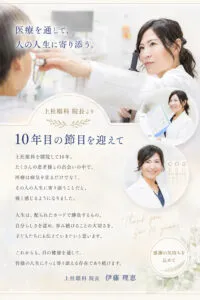
上社眼科 院長より10年目の節目を迎えて
医療を通して、人の人生を見るということ
― 上社眼科 院長として、この10年を振り返って ―
上社眼科を開院して10年。
この10年間、さまざまな年代、さまざまな背景を持つ患者様と出会い、医師として多くのことを学ばせていただきました。
人生の大先輩である患者様からは、病気のことだけではなく、長い人生を歩んできたからこその考え方や生き方を教えていただくことがあります。
一方で、子どもたちと関わるときには、医師として、そして少し先を歩く大人として、目の病気や視力のことを通して、その子が自分らしく成長していけるように、何かを伝えられたらと思っています。
最近、私は医師という仕事は、単に「病気を治す仕事」ではなく、
医療を通して、人と人として、その人の人生に関わらせていただく仕事なのではないか
と、強く感じるようになりました。
それは、これまで出会ってきた皆様のおかげです。
私が尊敬する方から、以前こんな言葉を聞きました。
「人生は、配られたカードで勝負するしかない。」
人は皆、それぞれ違うカードを配られて生きています。
家庭環境も、才能も、身体も、性格も、育った場所も、経験も違います。
だからこそ、誰かのカードと自分のカードを比べても、あまり意味はありません。
大切なのは、
自分に配られたカードをどう使うか。
今、自分が持っているものを見つめ、その中でどう努力し、どう人生をつくっていくか。
私は、それがとても大切なのだと思っています。
特に子どもたちは、まだ世界が小さいからこそ、
「どうしてあの子はできるのに、自分はできないんだろう」
「あの子の家はいいな」
「どうしてうちはこうなんだろう」
と、人と自分を比べてしまうことがあります。
でも、本当は世界はもっと広く、もっと多様です。
自分が今見ている世界が、世界のすべてではありません。
だからこそ、子どもたちには、少し先を歩く大人が、いろいろな世界を見せてあげることが大切なのだと思います。
日本だけではなく、異なる文化や価値観、さまざまな生き方を知ることで、
「人はみんな違っていい」
「自分は自分でいい」
という感覚を持てるようになるのではないでしょうか。
眼科の診療をしていると、目そのものには大きな異常がないにもかかわらず、視力が十分に出なかったり、視野に異常が見られたりするお子さんに出会うことがあります。
心因性の視力障害や視野障害です。
数か月、時には長い期間にわたって症状が続くこともあります。
もちろん、一人ひとり原因も背景も違います。
だからこそ、目だけを見るのではなく、
その子がどんな環境で、どんな気持ちで、どんな世界を見ているのか。
そこまで考えることも、医療の大切な役割なのではないかと思うようになりました。
そして「自己肯定感」という言葉があります。
私は、自己肯定感とは、
「自分をすごいと思うこと」だけではないと思っています。
弱いところも、得意ではないところも含めて、
「自分は自分でいい」
「今の自分を、まず自分自身が認めてあげる」
そこから始まるものなのではないでしょうか。
私自身、子どもたちを育てる中で、息子たちから教えてもらったことがたくさんあります。
子どもを育てているつもりが、実は自分自身も子どもたちに育ててもらっている。
そんなことを感じることもあります。
上社眼科を開院して10年。
これからも、目を診ることはもちろんですが、その人の背景にある人生にも目を向けられる医師でありたいと思っています。
そして私自身も、もっと世界を広げたい。
さまざまな場所へ行き、さまざまな人と出会い、異なる価値観に触れ、自分自身の視野を広げていきたいと思っています。
その経験を、これから出会う子どもたちや患者様にも、少しずつ伝えていけたらと思います。
人生には、それぞれ違うカードが配られています。
だから、人と比べるのではなく、
自分に配られたカードを大切にして、どう生きるか。
そのことを、医療を通して、そして一人の人間として、これからも皆様と一緒に考えていけたらと思います。
10年間、上社眼科に関わってくださったすべての皆様に、心より感謝申し上げます。
これからも、どうぞよろしくお願いいたします。
上社眼科
院長 伊藤 理恵
Ten Years of Medicine — and the Lessons Life Has Taught Me
Looking Back on 10 Years as the Director of Kamiyashiro Eye Clinic
It has been 10 years since I opened Kamiyashiro Eye Clinic.
Over these past ten years, I have had the privilege of meeting patients of all ages and from many different walks of life. Through each encounter, I have learned far more than medicine alone.
Some of my patients are much older than I am, and I have always felt that I am speaking with them not only as patients, but also as my seniors in life. Their experiences, perspectives, and stories have taught me many valuable lessons.
When I see children, I hope to be more than simply their eye doctor. As someone a little further along in life, I want to help them grow and discover what they are capable of through conversations about their eyes, their health, and sometimes the challenges they face.
Recently, I have come to feel more strongly that being a physician is not simply about treating diseases.
It is about seeing the person behind the illness and being allowed to share, even for a moment, in that person’s journey through life.
I believe this may be part of my calling—or perhaps my mission as a doctor.
And I owe this realization to all the people I have met along the way.
There is a phrase from someone I deeply respect that has stayed with me:
“In life, you can only play the cards you are dealt.”
Every person is given a different set of cards.
Our families, talents, personalities, bodies, environments, opportunities, and experiences are all different.
That is why comparing our cards with someone else’s does not always make sense.
What matters is not whether we were given the same cards as someone else, but how we choose to play the cards we have.
We should look honestly at what we have been given and make the greatest effort we can with those cards.
Children, especially, can easily fall into comparing themselves with others.
“Why can that child do it, but I can’t?”
“Why is their family like that?”
“Why isn’t my life like theirs?”
But a child’s world is still small.
They may not yet realize that the world is much larger and more diverse than what they can currently see.
That is why I believe adults have an important role to play in showing children a wider world.
Different countries.
Different cultures.
Different values.
Different ways of living.
By experiencing a wider world, children may gradually begin to understand that being different is not a weakness.
And perhaps they can begin to feel:
“I am allowed to be myself.”
In ophthalmology, I sometimes meet children whose eyes appear perfectly healthy, yet their vision does not improve as expected.
There are also cases of functional or psychogenic visual disturbances, including visual field abnormalities, which can persist for months or even years.
Of course, every child has a different background and different reasons for their symptoms.
That is why I believe we cannot look only at the eyes.
We also need to ask:
What kind of world is this child living in?
What are they feeling?
What kind of environment surrounds them?
Medicine, I believe, sometimes requires us to look beyond the disease and understand the person.
We often talk about “self-esteem” or “self-acceptance.”
To me, self-acceptance does not simply mean believing that you are wonderful or better than others.
It means being able to say:
“This is who I am.”
To accept yourself as you are—your strengths as well as your weaknesses, the things you are good at and the things you struggle with.
Perhaps self-acceptance begins with simply recognizing and accepting yourself without constantly comparing yourself to others.
I have learned much about this through raising my own children.
Sometimes, I feel that while I thought I was raising them, they were also teaching me how to live.
They have shown me, through their own lives, how self-acceptance can develop.
Ten years have passed since I opened Kamiyashiro Eye Clinic.
From this point forward, I hope to continue looking not only at my patients’ eyes, but also at the people and lives behind them.
And I want to continue expanding my own world as well.
I want to travel, meet people from different backgrounds, experience different cultures and perspectives, and keep widening my own view of the world.
Then, perhaps, I can share some of what I have learned with the children and patients I meet along the way.
We are all given different cards in life.
So rather than comparing our cards with someone else’s,
perhaps the most important thing is to value the cards we have been given—and decide how we will play them.
Through medicine, and simply as one human being meeting another, I hope to continue learning, sharing, and walking alongside the people who come into my life.
To everyone who has supported Kamiyashiro Eye Clinic over these past ten years:
Thank you from the bottom of my heart.
I look forward to the next chapter of this journey together.
Rie Ito, MD
Director, and Business Owner Kamiyashiro Eye Clinic