 ホーム
ホーム 医院紹介
医院紹介 診療案内
診療案内 手術
手術 先端医療
先端医療 ENGLISH
New Year Ophthalmic Seminar 2026 参加して(勉強会レポート)
2026年1月10日
毎年恒例となった New Year Ophthalmic Seminar 2026 に参加してまいりました。
(昨年のレポートはこちら)
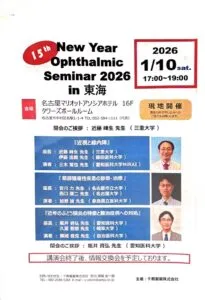
本セミナーは千寿製薬主催で開催され、
愛知県の4大学(名古屋大学・名古屋市立大学・愛知医科大学・藤田保健衛生大学)に加え、三重大学の教授陣が一堂に会する、非常に貴重な勉強会兼新年会(立食パーティ)です。
さらに今回は、浜松医科大学の教授もご参加。名古屋大学医局ご出身というご縁もあり、まさに中部圏の眼科医療を牽引する先生方が勢ぞろいする場となりました。
今回は、日々の当クリニックでの診療経験と重なる内容が多く、非常に感慨深いセミナーとなりました。
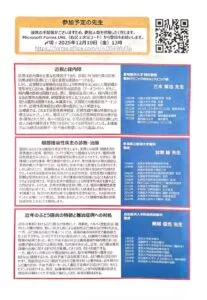
演題は以下の3つでした。
① 緑内障と近視
愛知医科大学病院 眼科クリニックMiRAI
三木篤也先生によるご講演です。
緑内障では視神経が障害されることは広く知られていますが、
実は、近視そのものでも視神経は徐々に弱くなることが分かっています。
特に近視が強くなるほど視神経の変化は顕著となり、
緑内障性視神経障害と近視性視神経障害の鑑別が非常に困難になる場合があります。
三木先生は、
「では、その違いをどのように見極めるのか」
という点を長年研究されておられます。
その中で、
緑内障では視神経の“篩状板(しじょうばん)”の構造異常が生じやすく、
緑内障患者さんの約73%に欠損が認められる一方で、
近視性の視神経障害では、同部位の欠損はほとんど認められない
という重要な知見を示されました。
さらに、近視そのものが将来的な視神経障害のリスクとなるため、
その因子をできるだけ早期に取り除く目的で、
小児期からの近視進行抑制治療にも積極的に取り組んでおられます。
当院でも、強度近視と緑内障を併せ持つ患者さまは決して少なくありません。
特に、眼軸長(目の長さ)が伸びるのを抑える治療は、小児期にしか介入できないという点は、
日常診療においても非常に重要な視点であり、改めて深く学ばせていただきました。
② 目の腫瘍
奈良県立医科大学 眼科教授
加瀬 諭先生によるご講演です。
目は、心臓と同様に腫瘍の発生頻度が比較的少ない臓器ですが、
ひとたび発見された場合には、迅速かつ的確な対応が不可欠な分野でもあります。
また、眼腫瘍を専門とする医師は全国的にも非常に少なく、
その意味でも、名古屋から約1時間40分で受診可能というアクセスの良さは、
「何かあった時に頼れる専門家がいる」という大きな安心材料だと感じました。
加瀬先生は、非常にユニークかつ理想的なご経歴をお持ちの先生です。
医学部卒業後、まず病理学教室に入局され、
その後、北海道大学(ご出身地)で眼科医としてのキャリアをスタートされました。
病理学、すなわち全身の病理組織を熟知したスペシャリストとしてのバックグラウンドを基盤に、
白内障手術はもちろん、硝子体手術、
さらに眼瞼下垂や内反症などの眼瞼手術まで幅広く習得され、
眼腫瘍性病変の治療を完結できる眼科医としてご活躍されています。
セッションの中では、
先生ご自身のご経験として、新型コロナウイルス感染症の病棟業務に従事されたこと、
しかもご自身は無感染のままその期間を過ごされたことについても触れられました。
さらに、コロナ感染後にみられる眼瞼腫脹に対する診療経験を踏まえ、
その病態に対する深い見識をもとに、
炎症性疾患として涙腺腫脹をきたす疾患群について、
臨床に即した非常に分かりやすいご説明をされておられました。
私自身も、コロナ禍の時期に、
同様の症状を呈する患者さまに外来で何度も遭遇し、
病院へご紹介したケースが少なからずあったことを思い出しました。
今回の講演では、
どのような場合に腫瘍を疑うべきか、
また、実際の治療方針はどのように立てられているのかを学ぶことができました。
その結果、
「ご紹介中に、どのような治療が行われてきたのか」
という背景まで理解できるようになり、
日常診療に直結する、非常に学びの多い内容でした。
③ ぶどう膜炎の特徴と対処
最後の演題は、自治医科大学 眼科教授 蕪城俊克先生による、眼科領域において極めて重要であり、**全身疾患との関わりが深い「ぶどう膜炎」**についてのご講演でした。
ぶどう膜炎の原因疾患は、この20〜30年で大きく変化しており、かつては50歳代に発症のピークがあったものが、現在では70歳代にピークが移行しているとのことでした。
また近年では、ヘルペス虹彩炎や眼内悪性リンパ腫が増加傾向にあり、
一方で、以前から代表的疾患として知られていたベーチェット病はやや減少しているという疫学的変化も示されました。
ぶどう膜炎の診療において、私たちが**常に最優先で念頭に置かなければならない疾患が「眼内悪性リンパ腫」**です。
その理由として、眼内に悪性リンパ腫が存在する場合、脳への播種を来すことが多いという重大な特徴があります。
硝子体内注射、全身化学療法、脳への放射線照射という複数の治療を組み合わせた集学的治療が可能であれば、5年・10年生存率が向上するという重要なお話がありました。(もちろん、年齢や腎機能といった制約があり、すべての患者さんに適応できるわけではありません。)
実は、このような症例を当院でも最近経験しており、
速やかに高度医療機関へご紹介させていただきました。
こうした症例や、生存率に直結する疾患の存在を改めて認識することで、たとえ可能性がわずかであったとしても、日常診療の中で常に希少疾患を念頭に置きながら診療にあたる必要があると、講演の終わりに強く心に刻みました。
当院では、日々の診療において、この信念と理念を大切にしながら、私自身が責任をもって診療にあたっております。
しかしながら、医療の現場では、いわゆる「車の渋滞の原理」と同じように、急な混雑や重症疾患への対応が重なった場合、診療の流れの中で一時的に待ち時間が発生してしまうことがあります。
特に年末年始には、通常であれば30分〜1時間でご案内できていた患者さまが、1〜2時間お待ちいただく状況が生じることもありました。
心苦しく思い、「クオリティを落とさざるを得ないのではないか」と悩んだことも正直にありました。
しかし、第一線でご活躍されている先生方が、こうした重症かつ命に関わる症例の治療に全力で向き合っておられる姿、そして、患者さま一人ひとりの人生そのものを考えたとき、決して診療の質を落としてはならないと、改めて強く思いました。
今後の診療においても、待ち時間の面でご迷惑をおかけすることがあるかもしれませんが、できる限りの工夫と改善を重ねながら取り組んでまいります。
何卒ご理解を賜りますよう、よろしくお願い申し上げます。
January 10, 2026
I had the pleasure of attending the annual New Year Ophthalmic Seminar 2026, a long-standing tradition in the ophthalmology community.
This seminar is organized by Senju Pharmaceutical and brings together professors from four major universities in Aichi Prefecture (Nagoya University, Nagoya City University, Aichi Medical University, and Fujita Health University), as well as Mie University.
This year, a professor from Hamamatsu University School of Medicine also joined the meeting, reflecting strong academic ties originating from the Nagoya University ophthalmology department.
The seminar serves both as an academic conference and a New Year’s standing reception, and it is truly a rare opportunity to learn directly from leading experts shaping ophthalmic care in the Chubu region.
This year’s seminar was particularly meaningful, as many of the topics closely reflected challenges we encounter in daily clinical practice at our clinic.
The program consisted of three main lectures:
1. Myopia and Glaucoma
The first lecture was delivered by Dr. Atsuya Miki from the Ophthalmology Clinic MiRAI at Aichi Medical University Hospital.
While it is well known that glaucoma leads to optic nerve damage, Dr. Miki emphasized that myopia itself can also cause progressive optic nerve vulnerability.
The stronger the myopia, the more pronounced the optic nerve changes become, sometimes making it extremely difficult to distinguish glaucomatous optic neuropathy from myopic optic nerve damage.
Dr. Miki’s research focuses on how to differentiate these two conditions.
He demonstrated that glaucoma often involves structural weakness of the lamina cribrosa, with defects observed in approximately 73% of glaucoma patients, whereas such defects are rarely seen in myopic optic neuropathy.
Recognizing that myopia is a significant risk factor for future optic nerve damage, Dr. Miki is also actively involved in research on early intervention for childhood myopia, aiming to prevent excessive axial elongation of the eye.
At our clinic, we frequently see patients with both high myopia and glaucoma.
The lecture strongly reinforced the importance of intervening during childhood, the only period when treatments to limit axial length elongation are possible.
2. Ocular Tumors
The second lecture was given by Professor Satoshi Kase from the Department of Ophthalmology at Nara Medical University.
Although the eye, like the heart, is an organ with a relatively low incidence of tumors, ocular tumors require immediate and accurate management once detected.
Moreover, ocular oncology is a highly specialized field with very few experts nationwide.
In this context, the fact that Professor Kase’s institution is accessible from Nagoya in approximately 1 hour and 40 minutes is reassuring, offering a reliable referral option when needed.
Professor Kase has a particularly impressive and unique career path.
After graduating from medical school, he first trained in pathology, later joining the ophthalmology department at Hokkaido University, his home region.
With a strong foundation as a systemic pathology specialist, he has mastered a wide range of ophthalmic surgeries, including cataract surgery, vitreoretinal surgery, and eyelid procedures such as ptosis and entropion correction.
This comprehensive skill set allows him to provide integrated diagnosis and treatment of ocular tumors, from pathological evaluation to surgical management.
His lecture clearly conveyed the value of an ophthalmologist who can oversee the entire course of care with deep pathological insight.
During the session, the professor also shared his personal experience of working in a COVID-19 inpatient ward, noting that he remained uninfected throughout this period.
Based on his frontline clinical experience, he discussed the management of post–COVID-19 eyelid swelling, and provided insightful, clinically grounded explanations of inflammatory diseases that cause lacrimal gland enlargement.
I personally encountered several patients with similar conditions in my outpatient clinic during the COVID-19 pandemic, and there were quite a few cases that required referral to a hospital for further evaluation.
Through this lecture, I gained a clearer understanding of when ocular tumors should be suspected, as well as how treatment strategies are determined and implemented in actual practice.
This knowledge allowed me to better appreciate the treatments patients receive after referral, making the session extremely educational and directly applicable to everyday clinical care.
③ Characteristics and Management of Uveitis
The final lecture was delivered by Professor Toshikatsu Kabuki from the Department of Ophthalmology at Jichi Medical University, focusing on uveitis, a critically important ophthalmic disease that is often closely associated with systemic conditions.
Professor Kabuki explained that the etiology of uveitis has changed significantly over the past 20 to 30 years.
Previously, the peak age of onset was in the 50s, whereas it has now shifted to the 70s.
In recent years, there has been an increase in cases of herpetic iridocyclitis and intraocular malignant lymphoma, while the incidence of Behçet’s disease, once considered a classic cause of uveitis, has shown a declining trend.
Among all causes of uveitis, intraocular malignant lymphoma is the condition that must always be prioritized in differential diagnosis.
This is because ocular lymphoma frequently disseminates to the brain, making early recognition and intervention crucial.
Professor Kabuki emphasized that when feasible, combined multimodal therapy—including intravitreal injections, systemic chemotherapy, and cranial radiotherapy—can significantly improve 5- and 10-year survival rates.
However, he also noted that not all patients are eligible for such intensive treatment due to factors such as age and renal function.
We recently encountered a similar case at our clinic and promptly referred the patient to a tertiary medical center.
This experience, together with the lecture, reinforced the importance of remaining vigilant for rare but life-threatening diseases, even when their probability appears low in daily practice.
At our clinic, I personally provide medical care with this philosophy firmly in mind.
Nevertheless, due to sudden congestion or the need to manage complex cases, temporary waiting times may occasionally occur—particularly during busy periods such as the year-end and New Year holidays.
There were times when patients who would normally be seen within 30 to 60 minutes had to wait one to two hours, which I found deeply regrettable.
I have often struggled with the concern of whether maintaining quality under such circumstances was possible.
However, reflecting on the dedication of frontline specialists treating severe, life-threatening conditions—and considering the profound impact on patients’ lives—I firmly believe that the quality of medical care must never be compromised.
We will continue to make every possible effort to improve our systems and reduce waiting times.
We sincerely appreciate your understanding and patience as we strive to provide the highest standard of care.